


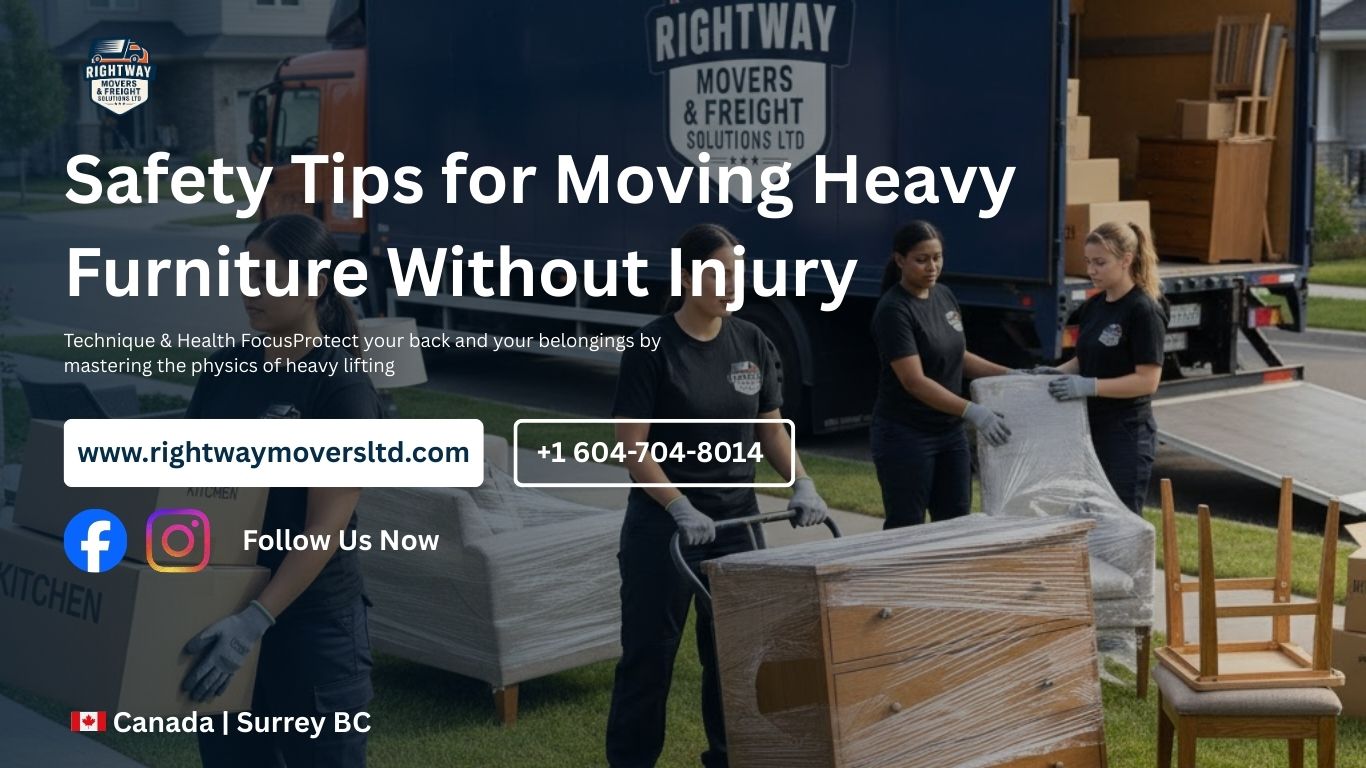
To master Safety Tips for Moving Heavy Furniture Without Injury, always lift with your legs—never your back—and maintain a wide stance. Utilize professional equipment like furniture sliders, forearm forklifts, and dollies. When in doubt, hiring Right Way Movers is the safest way to prevent long-term physical strain and property damage.
Heavy Lifting Safety Checklist
| Equipment | Purpose | Injury Prevention |
| Furniture Sliders | Reducing friction on floors | Prevents muscle pulls and back strain. |
| Moving Straps | Distributing weight to shoulders | Lowers the center of gravity; saves hands. |
| Shoulder Dollies | Lifting upright items (fridges) | Keeps the spine in a neutral position. |
| Protective Gloves | Enhancing grip | Prevents blisters and accidental slips. |
Why Should You Follow Safety Tips for Moving Heavy Furniture Without Injury?
Moving a household isn’t just a logistical challenge; it is a significant physical undertaking. Ignoring Safety Tips for Moving Heavy Furniture Without Injury can lead to chronic spinal issues, hernia, or severe joint damage. At Right Way Movers, our team undergoes rigorous training to handle heavy loads safely, ensuring that your furniture—and your body—remains intact.
The benefits of hiring professional movers for every relocation are primarily rooted in health and safety. While you might move once every few years, Right Way Movers handles heavy lifting daily. We have the muscle memory and the mechanical aids to ensure that a 300-pound dresser doesn’t become a medical liability.
What is the Proper Lifting Technique to Prevent Strains?
How do I lift heavy boxes without hurting my back?
The most fundamental of all Safety Tips for Moving Heavy Furniture Without Injury is the “squat-to-lift” method.
- Wide Base: Keep your feet shoulder-width apart.
- Squat: Bend at your hips and knees, not your waist.
- Core Tension: Tighten your abdominal muscles as you lift.
- Close Proximity: Keep the load as close to your body as possible.
Why should you never “twist” while carrying furniture?
[Insert Citation: Occupational Safety and Health Administration (OSHA) Manual Handling Guidelines]
Twisting while carrying a heavy load is the number one cause of disc herniation. According to our Safety Tips for Moving Heavy Furniture Without Injury, you should always move your feet to turn, rather than rotating your torso. If a path is blocked, Right Way Movers suggests setting the item down, clearing the path, and then resuming.
What Tools Are Essential for a Safe Move?
If you choose to handle some items yourself, integrating these tools into your Safety Tips for Moving Heavy Furniture Without Injury is non-negotiable:
- Furniture Sliders: These small plastic discs allow you to glide heavy sofas across carpet or hardwood with minimal effort.
- Forearm Forklifts: These straps use leverage to make heavy appliances feel 50% lighter.
- Moving Blankets: Beyond protecting the furniture, they provide a better grip surface than smooth wood or metal.
- Stair-Climbing Dollies: Essential for multi-story moves to prevent the item from “getting away” from you on an incline.
The benefits of hiring professional movers for every relocation include instant access to this high-end equipment. Right Way Movers arrives with a fully equipped truck, meaning you don’t have to buy or rent tools you’ll only use once.
How to Navigate Stairs and Tight Corners Safely?
What is the “High-Low” method for stairs?
When moving furniture up or down stairs, the person on the lower end should carry the item by its strongest point, while the person on the high end focuses on balance. This is a key part of Safety Tips for Moving Heavy Furniture Without Injury.
- Communication: Constantly talk to your partner. “Ready? 1, 2, 3, lift.”
- Rest Points: Identify landings where you can safely set the furniture down to catch your breath.
- The Right Way Movers Approach: We often use “ramping” techniques even on stairs to ensure a continuous, smooth motion that protects the crew’s joints.
Why Mental Assessment Prevents Physical Injury?
Is the item too heavy for you?
The most important of all Safety Tips for Moving Heavy Furniture Without Injury is knowing your limits. If an item feels unmanageable during the first “test lift,” do not proceed. This is where the benefits of hiring professional movers for every relocation become priceless.
Right Way Movers assesses the weight and dimensions of every piece before it moves. If an item is too large for a standard carry, we utilize hoisting or specialized rigging. We take the “ego” out of lifting to ensure a 100% injury-free environment.
Conclusion: Play it Safe with Right Way Movers
Your health is your most valuable asset. While it might be tempting to save a few dollars by lifting that oak armoire yourself, the risk of a lifelong back injury is a high price to pay. By following these Safety Tips for Moving Heavy Furniture Without Injury, you reduce your risk, but you don’t eliminate it.
The ultimate way to ensure a safe transition is to let the experts handle the strain. The benefits of hiring professional movers for every relocation are clear: your furniture arrives safe, and you arrive healthy. Visit https://rightwaymoversltd.com/ today for a free quote. Let Right Way Movers carry the weight so you don’t have to. Trust Right Way Movers—we move with care, the right way.
FAQ: Furniture Safety & Health
How to safely move heavy furniture?
To move heavy furniture safely and avoid injury, always lift with your legs, not your back. Keep the object close to your body to maintain your center of gravity, and never twist your torso while carrying a heavy load; instead, pivot with your feet to protect your spine.
What is the best way to avoid injury when moving an object?
If you have to move a heavy object without help, your best friends are sliders or a dolly. For hard floors, use felt pads or thick blankets under the legs to glide the furniture across the room without leaving scratches or gouges behind.
How to protect furniture when moving?
Prevent dicks and scratches by wrapping your pieces in moving blankets or bubble wrap, securing them with stretch plastic wrap. This creates a protective layer that absorbs impacts and keeps drawers or doors from swinging open during the transition.
What is the 2/3 rule furniture?
The “2/3 Rule” in furniture usually refers to visual balance and scale. For example, when hanging art over a sofa or placing a coffee table, the item should be roughly two-thirds the width of the furniture it’s paired with to ensure the room looks proportional and grounded.
VISIT MORE SITE :
White Glove Delivery Services in Surrey BC Canada
Freight Management Solutions in Surrey BC, Canada
Last Mile Delivery Solutions in Surrey BC Canada